
Investing in the People Who Heal Us
Scalable Model that Builds Ethical Resiliency in Healthcare.
The U.S. healthcare system suffers billions of dollars in losses annually due to staff burnout, turnover, and litigation risk.
Hospitals already have the solution:
Clinical Ethics Consultation (CEC) services.
However, these services are widely underutilized due to a fundamental failure of communication and strategy.

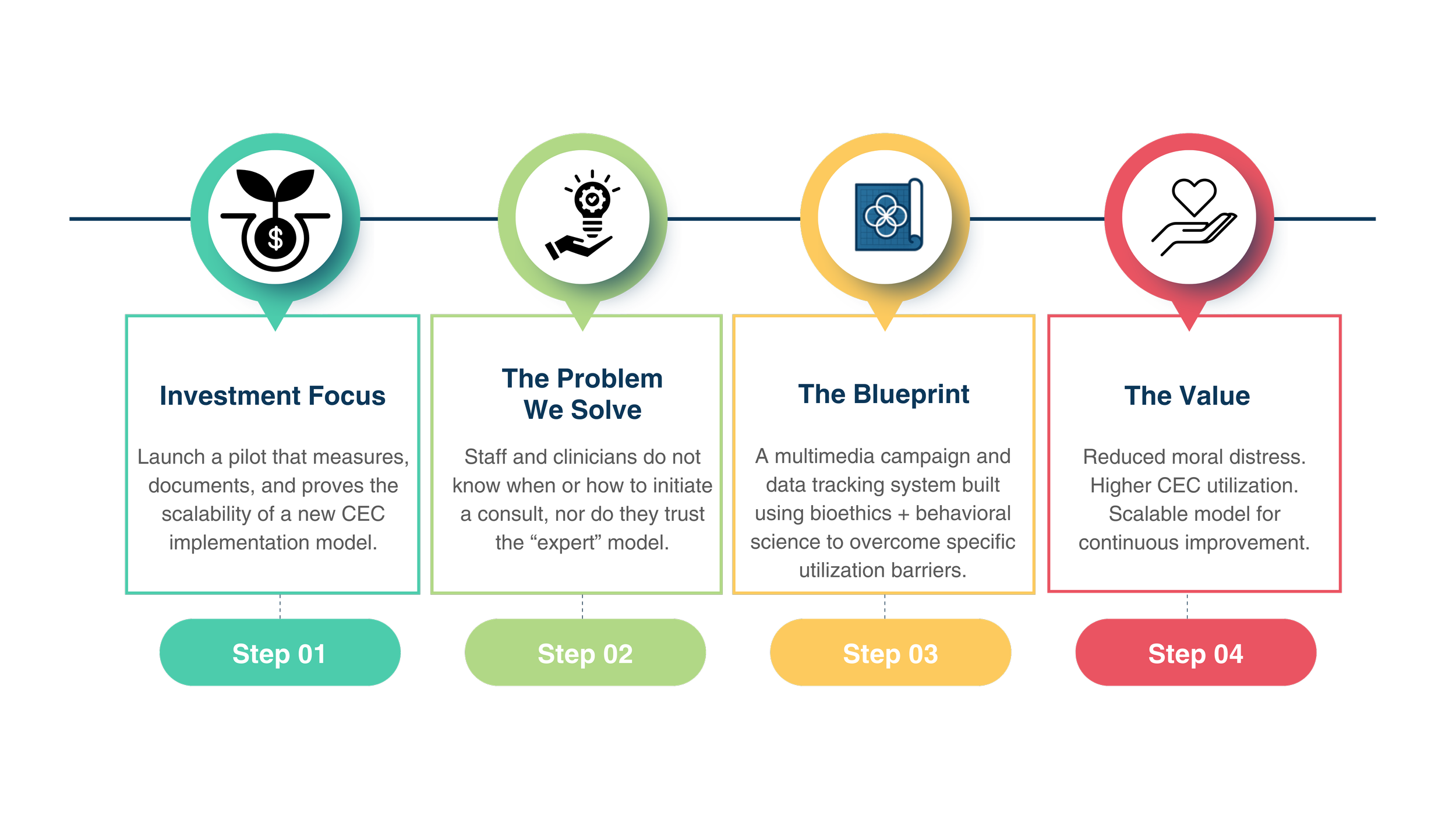
Our pilot program, The Ethical Resiliency Blueprint, creates an active instrument for moral clarity.
Pilot partnership with:


a High human-ROI Asset.
Clinical Ethics Consultation (CEC) is a multidisciplinary, structured service that facilitates consensus and alleviates moral burden during complex ethical dilemmas, transforming it from a mere decision-support tool into a proactive asset that systematically reduces litigation risk and the massive operational costs associated with staff moral distress and turnover.
-
CECs are multidisciplinary, on-demand services within a hospital that exist to guide decision-making when a moral conflict or complex ethical dilemma arises in patient care.
They are essentially a team of trained internal experts (including ethicists, nurses, doctors, social workers, and chaplains) who provide a structured process for resolution. They do not dictate decisions; they facilitate consensus and alleviate the moral burden on staff, patients, and families.
-
Anyone involved in a patient's care can initiate an ethics consult, including:
Frontline Staff: Nurses, residents, and attending physicians dealing with conflicting treatment goals.
Patients & Families: Who may feel their values or wishes are being ignored.
Administration: Dealing with resource allocation or complex policy issues.
-
CECs function as a crucial de-escalation and risk-mitigation tool in high-stakes situations. They are called in when the conflict is causing delays, distress, or legal exposure. The presence of clinical ethics teams within hospitals is not a modern luxury but a fundamental component of modern healthcare delivery. The importance of these teams is formally recognized by the nation's leading accrediting body. The Joint Commission, which accredits and certifies thousands of healthcare organizations and programs in the United States, requires hospitals to provide access to a mechanism for resolving ethical issues.
-
Example Case 1: A doctor feels obligated to continue treatment, but the family insists on stopping.
Example Case 2: A capable patient refuses a life-saving procedure against the medical team's advice.
The problem.
Awareness Gap: For Advanced Practice Providers (APPs), the primary reason for not requesting a consult was a lack of awareness—33.3% didn't know the service existed.
Access Gap: For nurses, the main barrier was not knowing how to contact the service (30.8%). This also affected APPs (27.8%), indicating a clear need for improved communication channels.
Misconceptions: While many healthcare professionals felt the need for help, a significant number, particularly physicians (41%), stated they "never felt the need for help." This suggests a misunderstanding of the service's full scope, which extends beyond crisis intervention to proactive support.
High Satisfaction, Low Utilization: The data shows that when the service is used, it is highly rated. The median satisfaction scores were high for all groups (Physicians: 76, APPs: 89, Nurses: 70), yet this positive feedback is not translating into increased utilization. This is a crucial point: the service is effective, but people aren't using it.
DOI:10.1186/S12910-021-00613-7.
The solution.
-
A Targeted Multimedia Campaign engineered using bioethics and behavioral science to diagnose and overcome the specific barriers to utilization.
-
A Data Collection and Tracking System that links our campaign touchpoints to utilization metrics, creating a fully documented, proprietary, and scalable implementation blueprint.
the pilot at
Boston Medical Center
Coming soon…
The pilot at Boston Medical Center is our dedicated R&D phase, where the seed capital will fund a measurable, data-backed pilot designed to prove this model can be scaled across any health system.